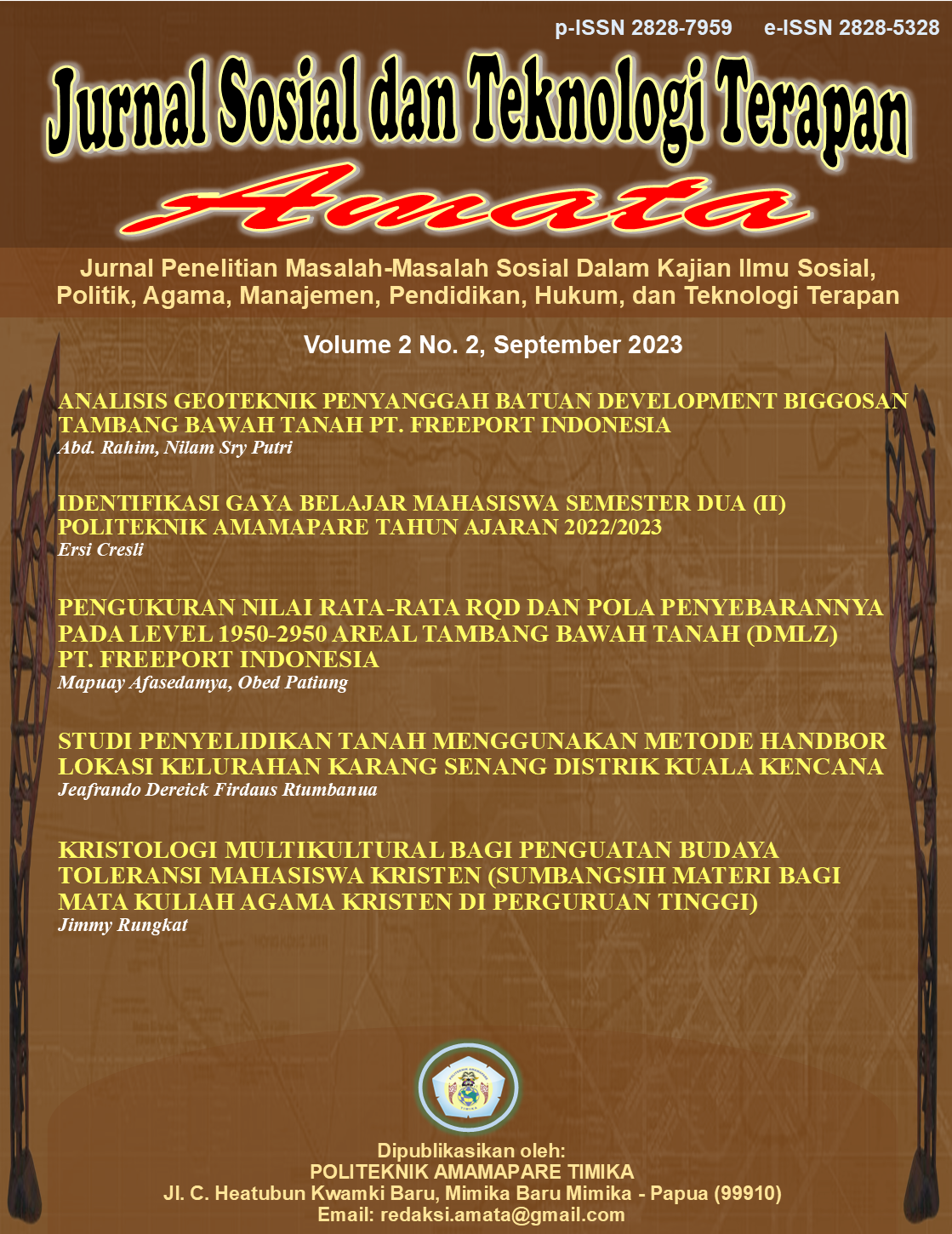
Identifikasi Gaya Belajar Mahasiswa Semester Dua (II) Politeknik Amamapare Tahun Ajaran 2022/2023
DOI:
https://doi.org/10.55334/sostek.v2i2.153Abstract
Penelitian ini bertujuan untuk mengidentifikasi gaya belajar visual, auditorial dan kinestetik Mahasiswa Semester Dua (II) Politeknik Amamapare Timika Tahun Ajaran 2022/2023. Metode penelitian yang digunakan dalam penelitian ini adalah deskriptif. Populasi yang diambil dalam penelitian ini adalah seluruh mahasiswa Semester Dua (II) Politeknik Amamapare Timika Tahun Ajaran 2022/2023. Sampel yang diambil sebagai sampel penelitian berjumlah 68 orang dengan menggunakan teknik simple random sampling. Instrumen yang digunakan dalam penelitian ini berupa angket/kuesioner dengan menggunakan tiga jenis gaya belajar yang mencakup gaya belajar visual, gaya belajar auditorial, dan gaya belajar kinestetik. Hasil penelitian menunjukkan gaya belajar visual 43 mahasiswa atau 63,2 %, gaya belajar auditorial sebanyak 22 mahasiswa atau 32,4 %, dan gaya belajar kinestetik 3 mahasiswa atau 13,2%. Mahasiswa Semester Dua (II) Politeknik Amamapare Timika Tahun Ajaran 2022/2023 cenderung memiliki gaya belajar visual sebesar 63, 2%.
Downloads
References
Ahmadi dan Supriyono. 2008. Psikologi Belajar. Jakarta: Rineka Cipta.
Bire, Arylien Ludji., Geradus, Uda & Bire, Josua. 2014. Pengaruh Gaya Belajar Visual, Auditorial, dan Kinestetik Terhadap Prestasi Belajar Siswa. Jurnal Kependidikan, Volume 44, Nomor 2. NTT: Universitas Nusa Cendana.
Deporter, Bobbi. 2003. Quantum Learning. Bandung : Kaifa.
Ghufron, N & Risnawita, R. 2014. Gaya Belajar. Yogyakarta : Pustaka Pelajar.
Hasrul. 2009. Pemahaman Tentang Gaya Belajar. Jurnal Medtek, Volume 1, Nomor 2. Makassar: Fakultas Teknik UNM
Rambe dan Yarni, 2019. Pengaruh Gaya Belajar Visual, Auditorial, dan Kinestetik Terhadap Prestasi Belajar Siswa SMA Dian Andalas Padang. Riau: Jurnal Review Pendidikan dan Pengajaran Universitas Pahlawan.
Subini, N. 2012. Mengatasi Kesulitan Belajar Pada Anak. Jogjakarta: Javalitera
Sukadi. 2008. Progressive Learning. Bandung: MQS Publishing.
Downloads
Published
Issue
Section
License

This work is licensed under a Creative Commons Attribution-ShareAlike 4.0 International License.
Copyright and Licensing
Authors who publish their work in the Jurnal Sosial dan Teknologi Terapan AMATA agree to the following terms:
The Creative Commons Attribution-ShareAlike 4.0 International (CC BY-SA 4.0) license permits anyone to copy, distribute, display, and create derivative works from the original work, including for commercial purposes, provided that the following requirements of the Creative Commons Attribution-ShareAlike 4.0 license are observed:
Key License Terms
- Attribution (BY):
- Users must give appropriate credit to the original copyright holder/author.
- Users must provide a link to the license.
- Users must indicate whether any changes or modifications have been made to the original work.
- ShareAlike (SA):
- If users remix, transform, modify, or create derivative works from the original material, the resulting work must be licensed under the same or a compatible license (CC BY-SA 4.0).
- No Additional Restrictions:
- Users may not impose additional legal or technological restrictions that prevent others from exercising the rights permitted by this license.
What the Public May Do
- Share: Copy and redistribute the material in any format or medium.
- Adapt: Remix, transform, adapt, and create derivative works for any purpose, including commercial purposes.
Note: The copyright holder retains ownership of the original work. This license only grants the public permission to use the work subject to the terms and conditions specified above.